Showing posts with label stocks. Show all posts

Sunday, February 17, 2013

Survival of the Fittest for Investors

by Dick Stoken


I read two thirds of this book on a flight back from Mexico. I was disappointed to find that the bulk of the book comprised charts and past data which the author showed supported his theories and investment ideas. Of course, that’s easy when you get to pick the data. More than that, however, this book has some other problems.

Although , I won’t argue against anyone, including this book’s author, who says the stock market is a living system and can be analyzed scientifically using biological theories and methodologies, I will argue that diversification (of investments) is not the same as biological variation, and portfolio re-balancing is not the same as adaptation. Stretching the definitions may be a good investment angle, but it won’t necessarily make you money. Also, several elements seemed out of place, like starting off with a discussion of Newton so that he could show Darwin to be “more applicable” to investing, or his tendency to resort to describing bubbles and how they could be avoided as defense of his methodologies. I just kept wanting to say, yeah, the ten years from 1929 on were a bad time to be investing, we get it. So, now what?

If I had read this entire book, it is possible I may have found some useful nuggets at the end, but the first two thirds of the book were so drab, I just had to put it down. There is stuff to be learned in this book, and I really like the author’s original idea, but overall, it’s just not that useful and really only worth two dollar marks.

Monday, February 13, 2012

Maverick Trading

by three guys from that company


When I first heard the title of this book, I thought what I was getting into was another “Here’s a scary and crazy way to make money in stocks that you've never heard of before” books. I mean, I hear “Maverick” and I’m thinking cowboys, whiskey, and poker games that end in gunfights. So I figured Maverick trading would be just that: some bold new take on investing in stocks where you keep the whiskey close by in case things don’t go well. (If that were the case, what you do with the gun is another story, too.) Turns out that Maverick is the name of the company (and the trading philosophy) of the three authors of this book, and Maverick Trading’s only thread to the other Maverick is, you try to make money.

The book starts with basic explanations of what moves markets: buyers and sellers. It also discusses why buyers buy and why sellers sell, and what happens when they don’t. They cover the basics of stock charts so that even a raw beginner can obtain and understand useful information on market movement. From there, the nuts and bolts of how markets move, along with the intricacies of analyzing stock positions and behind the scenes movements in prices, sectors, and industries are covered in some detail. I suppose more sophisticated traders than myself might find some of what Maverick is about to be too basic, but I have been investing in stocks for 26 years and never really considered looking at the market the way Maverick does. And of course, I also never thought it might be possible to see when large movements take place and what the real opportunity to buy or sell an equity might be based on what other people are doing. To some extent that makes this a trend book, but Maverick teaches you how to get information, how to analyze it, what to do with it, and when to act on it, regardless of trends. That makes it a complete package for successful trading. The “tools” they put in your “toolbox” are understandable, logical, rational, and eminently useable. And because they advocate infrequent trading only after the big picture is understood, I’m thinking that Maverick trading is a good risk limiting tool, too.

I like this book not only because of the information it contains, but because of its earthy, friendly, approachable tone. Some of the authors’ analogies can at times be ridiculous but the points they are trying to make get illustrated and illustrated well. It makes learning the Maverick way a breeze and reading the book is a pleasure. I didn’t have to buy this book, but it’s one that had I purchased it for myself, I still would have been very satisfied. I give it five dollar signs for that reason.

Thursday, December 22, 2011

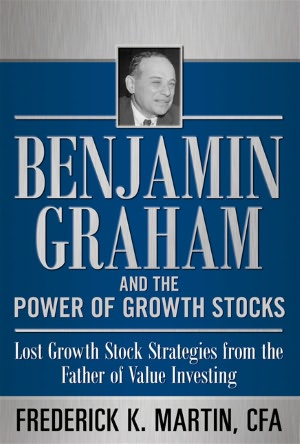
Benjamin Graham and the Power of Growth Stocks

by Frederick K. Martin


Compared with other books that I have read about Ben Graham, Benjamin Graham and the Power of Growth Stocks is definitely the clearest, most concise, and easily the most useful of all of them. What makes this book particularly interesting is how it revisits the investing philosophy of Mr. Graham with an angle toward using, maybe even zeroing in on, just growth stocks. Once it defines growth stock and clarifies why Mr. Graham’s principles apply, it can then expound on the most tangent of Mr. Graham’s principles and expand them in light of the modern investment environment. What really makes this book a winner is how it reproduces a long lost formula of Mr. Graham’s and then explains a tangible, executable method for actually using that formula to calculate the value of a growth stock and whether or not it is one that should be invested in. Too often we hear some investment advisor tell us, “This formula works, unless of course it doesn’t”. There is none of that here. You set the margin of safety (explained in the book) where you are comfortable. You set the growth rate (here called the “hurdle rate”) you need (or want) to achieve. You look up or calculate the values for the company you want to invest in. Then you apply Graham’s formula. If the numbers match, you’ve found a stock you can safely and confidently invest in. If they don’t, you have to keep looking or change your expectations. The choice is left to you. While I wouldn’t recommend this approach to a beginner, I think this methodology is ideal for a disciplined investor. By constantly referring to Graham’s teachings, the author has really reached an investment methodology that is understandable, achievable, and repeatable. The writing is crisp and friendly, and the style is homey without being corny or preachy. Above all, the author has a solid understanding of the investment principles of Ben Graham, as well as experience using them, and producing positive investment results. Without a doubt, Ben Graham’s growth stock approach is sensible, making this book probably the best investment book I’ve read this year. That’s definitely worth the full load of dollar marks.

Thursday, June 2, 2011

Trading with Candlesticks

by Michael C. Thomsett


About ten years ago, I was invited by a local newspaper to participate in an eight week stock picking contest with seven other individuals, each with a different approach to stock picking, presumably to find the best money making stock trading strategy. As the author of a gambling book, Winning Pachinko: The Game of Japanese Pinball, I was to make use of a "gambler strategy". My result was less than spectacular (4th out of 8, so top half, anyway), while the winner more than doubled his fantasy $100K using "Japanese candlesticks". He did so in about ten weeks of trading. So when I saw this book, I was anxious to see if I could become a candlestick convert, as it were. Unfortunately, this book is very good at teaching about candlesticks, but not very good at the “trading with candlesticks” part. In fact, every time I thought the author had given me an useful nugget or insight, the next paragraph would say, “Of course, it could be a false signal.” It’s second guess after second guess. But that’s not the worst part. The worst part is that the authors never draw any sort of correlation between their candlestick charts and what was going on in the real world. There’s nothing that reflects what the economy was doing at the time (was it a bear market? bull market? stagflated? irrationally exuberant?), and nothing about what the company itself was doing (changing CEO’s? releasing a new product? covering up a sex scandal?). Had there been anything at all that allowed a potential trader to put two and two together on his or her own, this book could have been really valuable. As it is, it’s nothing more than a treatise on one of many stock analysis tools, limiting its utility considerably. All in all, the book was informative, well written, and well thought out. It had lots of illustrative charts and graphs (some not all that useful, however), and it was organized well, progressing from easy single stick patterns to multiple stick patterns. There just wasn’t much meat on these relatively solid bones, resulting in my lukewarm three dollar sign rating.